This glossary explains biological, botanical, zoological and mycological terms, as well as terms used in cecidology. It is intended to make the numerous technical terms used in the photo gallery and on the information pages of this website easier to understand.
All | A | B | C | D | E | F | G | H | I | J | K | L | M | N | O | P | Q | R | S | T | U | V | W | X | Y | Z |

Caeoma
Simple aecia without peridia (caeomata with caeomatospores). The image shows a detail of Coleosporium tussilaginis sensu lato.

Capillitium
The capillitium is the entire system of hairs or threads inside spore-bearing structures. In mycology, the term is used primarily for the hair-like structures in the mature gleba of gasterothecia, and also for similar structures inside the sporocarps of slime moulds (Myxomycetes).

Cecidology
Cecidology is the scientific study of plant galls. Galls are induced by many different organisms, such as gall wasps, gall midges, leafroller moths, gall mites, fungi, bacteria and viruses. They serve for reproduction or protection against weather and predators. Plant galls develop in different ways. In insects, plant tissue is altered by the injection of cytokinins, producing characteristic gall forms. These injections can stimulate, inhibit or regenerate growth. Histoids and organoids are distinguished. Organoid galls are characterised by changes in individual plant organs, such as changes in shape, anomalies of leaf arrangement and branching, and the formation of new organs. Histoid galls are recognised by changes in plant tissue, such as felt, pith, covering or blister galls, and leaf rolls or folds. Plant galls may also serve as refuges for inquilines (animal species living in abandoned but still inhabited galls, mines, galleries or nests of other species) and parasites, which usually ultimately results in the death of the gall inducer.
Cellulose
Cellulose is the main component of plant cell walls and is therefore the most abundant organic compound and the most common polysaccharide.

Claustral
In myrmecology, claustral colony founding is the process by which an ant queen establishes a colony independently. After mating she sheds her wings, burrows into a founding chamber and seals it. There she lays the first eggs, from which larvae, pupae and later workers develop. The queen supplies the resources for raising the larvae from her own body by breaking down flight muscles and the fat body (fat reserves in the gaster).
Cleistocarpous
A term for fungal fruiting bodies without a preformed opening or specialised opening mechanism. Spores are released through weathering or, in zoochorous dispersal, through mechanical and/or chemical destruction of the wall, for example in the giant puffball (Calvatia gigantea).

Cleistothecium
A cleistothecium is an almost spherical ascoma without a preformed opening, with a single- or multilayered wall. Cleistothecia are often surrounded by envelope cells or peridia. The spores are released through mechanical destruction of the cleistothecium or through swelling of internal structures that cause it to rupture. Cleistothecia are formed, for example, by the genera Emericella and Eurotium.

Coleopterocecidia
Coleopterocecidia are plant galls induced by beetles, for example weevils (Curculionidae).
Collar
A ring-shaped ledge in the cap flesh separating the gills from the stipe, for example in parasol mushrooms (Macrolepiota), or a ring-shaped collar-like structure, for example on the endoperidium of earthstars (Geastrales).

Commensalism
Commensalism is an interaction between individuals of different species that benefits one species while having a neutral effect on the other. The term is used somewhat differently in different fields. In the original definition, based on the work of the Belgian parasitologist and palaeontologist Pierre-Joseph van Beneden, a commensal is an organism that depends on another species for food by sharing its food resources but, unlike a parasite, does not harm it. In close association, the organism providing the food is called the host and the organism benefiting from it is the commensal. The host experiences neither benefit nor harm. The commensal alone benefits from the association and is usually dependent on the host. It mainly feeds on waste products or surplus food from the host without removing substances essential to the host’s survival.
Conidia
Conidia are a type of fungal spore and the term is also used for spores of prokaryotes of the genus Streptomyces. In fungi, they are mitospores and are produced asexually (mitotically), outside the sporangium, either by modification of hyphae or on conidiophores. They are characteristic dispersal structures of vegetative reproduction in higher fungi, including ascomycetes and basidiomycetes.
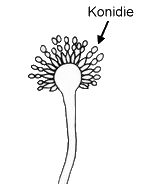
Conidioma
A fruiting structure of imperfect fungi in which a clearly differentiated fruiting-body wall is formed.
Conidiophore
A conidiophore is a conidium-bearing hypha that is clearly differentiated from the vegetative mycelium.
Coprophilous
coprophilous = dung-, manure- or faeces-inhabiting. In mycology, coprophilous fungi are species that grow preferentially or exclusively on animal excrement.
Cortex
The cortex is the cortical layer of fungal fruiting bodies.
Cortina
A filamentous or veil-like protective covering, mainly between the cap margin and stipe, as in Cortinariaceae.

Covering gall
A covering gall is produced when the gall inducer stimulates strong, ridge-like growth around itself on the leaf surface and later becomes enclosed by it. A small exit hole often remains through which the insect can leave the gall after development, for example the gall of the beech gall midge (Hartigiola annulipes).
Cryptic species
A cryptic species is a morphologically indistinguishable group or population of organisms in which sexual reproduction with individuals previously regarded as belonging to the same species is impossible or produces only non-viable offspring. This is referred to as reproductive isolation. Since an important criterion in the biological species concept—the ability to reproduce with one another—is not met, the organisms cannot belong to the same species.
Cyanophilous
Able to be stained with aniline blue, methyl blue or cotton blue; important for staining spore ornamentation, for example in coral fungi and cup fungi.
Cystidia
Sterile cells that differ clearly from the surrounding cells. Cystidia occur in the hymenium (hymenial cystidia), on the gill edge (cheilocystidia), on the gill surface (pleurocystidia), in the pileipellis (pileocystidia) and on the stipe surface (caulocystidia). Cystidia whose refractive contents turn yellow with KOH (potassium hydroxide) are called chrysocystidia. Cystidia with oily contents are called gloeocystidia; their contents turn wine-red with sulfovanillin.
Cytokinins
Cytokinins are a group of plant hormones that influence plant growth and development. They also occur in animal tissues, bacteria, fungi and algae.
TOP