
This glossary explains biological, botanical, zoological and mycological terms, as well as terms used in cecidology. It is intended to make the numerous technical terms used in the photo gallery and on the information pages of this website easier to understand.
All | A | B | C | D | E | F | G | H | I | J | K | L | M | N | O | P | Q | R | S | T | U | V | W | X | Y | Z |

Gall midge
There are about 5,000 species of gall midges (Cecidomyiidae) worldwide, including about 700 species in Central Europe. They owe their name to the formation of galls on various parts of their host plants, such as grasses, shrubs and trees, in which their offspring develop. High concentrations of cytokinins have sometimes been found in the galls, influencing plant and gall growth and development. Gall midges spend most of their lives in the larval stage and some species are parasitic or predatory. Adults live only for a short time. After four larval stages, the developing gall midges pupate in their galls. Gall midges feed exclusively on plants and do not transmit diseases to humans.
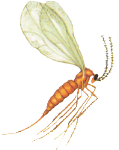
Gall mites
Gall mites (Eriophyidae) are tiny mites only about 0.2 mm long. Through their feeding activity they cause characteristic galls on many different plant species. Depending on the species, these galls may take forms such as shoot deformities or pox-like structures on leaves. Gall mites usually overwinter in leaf axils or between the bud scales of their host plants and move onto the leaves when the plants sprout in spring. Each gall mite species is specialised on a particular host.

Gall wasp
Gall wasps (Cynipidae) comprise about 1,600 species worldwide and around 300 in Central Europe. Most develop in plant galls, but some also occur in other insects as parasites or parasitoids. Reproduction is either normally sexual or partly parthenogenetic. In most species there is alternation of generations, with a sexual generation and one or more parthenogenetic generations. The larvae develop in galls produced by chemical and/or mechanical stimuli and feed on their tissue.

Gasteroid fungi
Gasteroid fungi (Gastromycetes or Gasteromycetes) are an obsolete form taxon in the fungal kingdom because the polyphyletic origin of the groups assigned to it has since been demonstrated. The taxa concerned are now systematically assigned to the basidiomycetes. Gasteroid fungi are characterised by the fact that basidiospores are formed inside the fruiting body. The spore-bearing part, actually a gasteroid basidiocarp, is called a gasterothecium.
Gasterothecia
Gasterothecia are angiocarpous or cleistocarpous fruiting bodies of gasteroid fungi (Gasteromycetes), for example earthstars (Geastrum), bird’s-nest fungi (Nidularia), splash cups (Cyathus), puffballs (Bovista) and puffballs (Lycoperdon).
Geotropism
Geotropism is the movement of fungi, plants or plant organs towards (positive geotropism) or away from (negative geotropism) the centre of the Earth. Shoots are always negatively geotropic, whereas roots grow positively geotropic. If the position of the substrate changes, for example when a tree bearing fruiting bodies of the tinder fungus falls over, the fungus changes its growth direction after some time.
Germ pore
A thin, pore-like area visible under the microscope at the apical pole of the spore wall, from which the germ tube later emerges. This germ pore occurs only in certain genera of basidiomycetes.
Germ slit
An elongated, slit-like thinning of the spore wall in certain ascomycetes, for example in Xylariaceae, usually along the long side of the spore.
Gills
Radially arranged plates on the underside of agaric fungi. They increase the surface area of the fertile layer located on their sides. Ridges, spines and tubes in other fungi serve the same purpose.

Gleba
In mycology, the gleba is the fertile part of angiocarpous and cleistocarpous (cleistothecial) basidiomycetes.

Guaiac tincture
A resin obtained from the guaiac tree, dissolved in alcohol, which can produce a blue coloration on fungal fruiting bodies.
Guttation
The excretion of liquid secretions in the form of droplets.
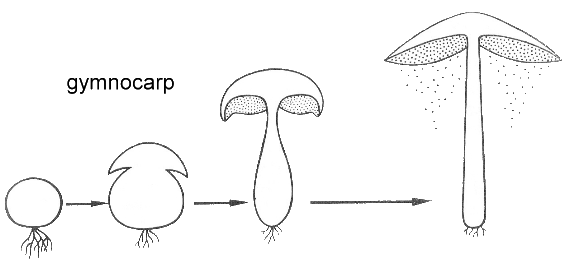
Gymnocarpous
Gymnocarpous fungal fruiting bodies are those in which the asci or basidia develop on the surface and remain uncovered by the fruiting-body wall, velum or similar structures throughout development until spore maturity.
TOP